Bill Pentz Aircompressor Purchasing Advice
Table of Contents
(click on topic to go there)- Introduction
- Acknowledgements
- Urgency
- Background
- Air Compressor Basics
- Components
- Specificaitons
- Oil-less Versus Belt-Driven
- Cylinders
- Single Stage Air Compressor
- Two Stage Air Compressor
- Horizontal Versus Vertical Compressors
- Compressor Valves
- Compressor Pressure Sensor Switch
- Pressure Relief Valve
- Check Valve
- Air Tank
- Motors
- Hoses
- Requirements
- Recommendations
- Making a Choice
- Introduction
Jack Dunn, my cousin, has long worked as a mechanic, contractor, and equipment repair specialist. He has been a godsend over the last fifteen years helping me with projects that I just can no longer do due to a bad leg. He used my air compressor for a project and during that effort it developed a knock. He advised me that I could fairly easily repair my unit with new or rebuilt parts, and he would be happy to do the rebuild for a reasonable fee. We discussed my wanting to upgrade to enough capacity to do the high volume low pressure (HVLP) spraying I wanted to do. After doing some checking, he said upgrading the pump and motor would cost nearly as much as buying new, and he was not comfortable putting that larger equipment on my old tank. He said it was time to seriously consider buying a new bigger unit.
- Acknowledgements
This effort started simply as a means for me to go about upgrading my old compressor. As with most things the more I looked into this area, the more there was to consider. Just as I discovered when looking into Cyclones & Dust Collection much of the available information provided by hobbyist suppliers is advertising hype. Sorting through that hype took far more expertise and knowledge than I had personally. I relied considerably on the many excellent post that were archived on the Badger Pond, the Oak, and Wood Central woodworking forums. Although many helped and provided their information, almost always what I heard traced back to a single individual, Forrest Addy. Forrest has been an incredible resource in many areas for woodworkers and has helped me personally often and well. He consistently declines the few favors that others and I have tried to send in his direction. I admit right up front with considerable embarrassment that much of the material for this page came directly from Forrest's considerable sharing. I was recently made aware that this material he shared is from his copyrighted publication called the "Practical Machinist". Because of the way I built this site from a single MS Word file that grew and grew, it was utterly impossible to separate off his efforts and give him his credit due. As a result, I have taken this page down and am in the process of a total rewrite that will give him his credit. My thanks to all as you helped me get an excellent unit that if I take care of it should last for many years! Much of what I learned was a real eye opener!
- Urgency
My first job was to determine the urgency of my need. My Craftsman air compressor after over 25 years of good service developed a bad knock. My retired friend who owned that air compressor business said it was not wise to rebuild mine. A tank that old will often have serious rust problems that can be dangerous. He responded to my dumb look saying a 125 PSI unit like mine won't fly around the shop too long if a major seam lets go and rarely will they fly more than about sixty feet. He then paused and said only once in a very great while will an old tank explode and make a big mess, but mostly they just develop pinholes from rust and leak air badly. He said I could probably get another year or more out of my compressor and many more than that from my tank by just keeping up the oil, draining the water regularly, and using it sparingly. He was right and I spent a couple of years at leisure looking for a replacement based on his advice.
- Background
My little home unit was a Sears that Dr. Mike O'Brien of UC Davis Agricultural Engineering Department helped me pick back in the late sixties. That particular unit was one of the many lines that Sears has custom built by better name suppliers. The one he helped me choose had a top quality motor, one of the better brand name pumps, good safety features, and was well built. As with so much of his advice, that I now dearly and sorely miss, he was correct as that unit served me well for nearly three decades.
Perhaps I'm strange, but from the time when I left home in high school to become self supporting, I'm terribly careful when it comes to buying anything as I want quality, reliability, and the assurance of long term serviceability. Both from personal experience and from being a quality control and purchasing engineer for the State of California I learned "the sweet taste of a good bargain vanishes quickly when you have to live with the bad taste of a poor quality product".
I wanted a compressor that will carry me into retirement. I've used air compressors in the auto repair and body shops I've owned, used them when working as a machinist apprentice in the sixties, and used them both at home and at the university where I have taught engineering part time for twenty-eight years. In spite of all that use, I never paid much attention to them unless they broke. My philosophy was to simply buy top quality, set it up right and get on with whatever needed doing.
I then took that list to a long time friend and prior neighbor who has long owned an air compressor store since his retirement as a machinist. My friend said he owed me considerably for my help on dust collection, so spent many hours in going over what considerations went into selecting a good air compressor. He crossed off the rumor, wrong, or poor advice. He added considerable material of his own as well as shared many stories backing up both what he read and what he contributed, including his own loss of a brand new car. He went through his parts and repair inventory showing me the different kinds of pumps, showed me how a two stage works and the inter-cooler, plus the various valves, switches, drain systems, and many accessories that he carries in his store. He also shared with me many examples of ruined equipment such as pumps, oil-less pumps, belts, valves, and tanks that were not properly maintained or used beyond their design limits. He suggested I put that information on a web page similar to my dust collection as many could benefit.- Air Compressor Basics
- Components
Small shop and home air compressors are fairly simple. A motor turns a pump that feeds air through a backpressure valve into an air tank. That backpressure valve keeps the compressor from having to work against the already compressed air. The motor is turned on and off by a pressure switch mounted on the tank. A pressure relief valve (sometimes called a pop-off valve) keeps the tank from getting too much pressure. Some air compressors let you use that pressure relief valve to quickly empty the pressure from the tank after use. Most also have a tank valve (sometimes called a stop valve) that can be sealed to keep the tank pressurized without having to keep your hose pressurized. This is something you always should use if you leave your tank pressurized! Most air compressors also have a tank drain to drain the water that condenses on the inside of the tank. Often there's a pressure regulator built into or mounted on the tank after that tank valve to set a fixed pressure for your hose. Most bigger and better quality air compressors use an unloader valve that opens on startup to let the motor come up to speed before the compressor starts to build pressure. Many people also add a dehumidifier to take the condensed water out of the line to keep from hurting your spaying efforts or putting water through your air tools.
- Specifications
The first thing I learned is picking a compressor based upon manufacturer sales literature is nothing short of foolish. Vendors have learned that truth in advertising now means they only have to prove their product can meet whatever they claim for an instant. This would be like me selling you my car and claiming that it gets 92 miles per gallon. If you look at the MPG gauge when coasting down a mountain, it actually gets that MPG, but in real use what I can count on is far less. The same sadly applies today to a good portion of the consumer goods being sold, particularly tools, motors, dust collectors, and air compressors. I guess whichever firm can make the biggest sales claim sells the most units. If you don't take the time to learn about air compressors, then you just add to this problem! Worse, what you don't know about compressors will waste your money and can kill you and others!
For compressors you have to adjust considerably to go from the advertised specifications to get a compressor that will meet your needs. Check the horsepower rating on the motor nameplate. If the plate is blank or says something like "special" then the motor rating will be totally different. If you multiply volts times amps then divide by 1100 (not 746) you will get a rough idea of the actual HP figure.- Oil-less Versus Belt-Driven
Oil-less compressors as their name implies do not require lubrication. They generally have a motor directly driving the pump. This makes for a simple and reliable compressor if used lightly. Typically they are noisy, not very efficient, low cost entry-level units designed for the occasional user where high duty cycle and longevity isn't a major consideration. Most small oil-less compressors will power a nail gun, pump up tires, and supply an occasional blast of air. When used in this mode only, these units will last for years and can be very handy. However, they are not intended for steady use where the pump runs more than about 20% of the time in spite of many trying to use them that way. When you start using a paint sprayer, air tools, a sand blaster, or other high demand air tools, you can quickly ruin an oil-less compressor in a matter of hours, as they were never meant for continuous or high-volume use.
For oil-less compressors the incoming air passes through a rudimentary filter but their crank assemblies and the bottoms of the pistons and cylinders are exposed to ambient air and whatever dust it carries. If the air in your shop is damp or dirty with abrasive or other particles like sawdust, these materials will clog your filter and shorten the life of your pump through corrosion, wear, or seal deterioration. It generally costs more to repair an oil-less compressor pump than it does to replace it.Belt-driven compressors use an induction motor driving a fan belt that turns a larger wheel on a compressor. The better belt-driven compressors have vanes on that compressor drive wheel so it also serves as a cooling fan to help get rid of the considerable heat generated when compressing air. Belt driven compressors are quieter, more efficient, and last longer. Belt driven compressor pumps are built like an internal combustion engine where the crankshaft and other parts run in a sealed crankcase. These pumps are either splash or pressure lubricated with oil. There is no particular advantage to a pressure-lubricated compressor over a splash-lubricated compressor provided they are properly designed. Often good quality belt-driven compressors will serve reliably for twenty or more years with little or no maintenance other than filter and oil changes.
- Cylinders
Most consumer air compressors come with either one or two cylinders.
- Single Stage Air Compressor
All single cylinder units and most two cylinder consumer grade air compressors are single stage air compressors. This means they directly compress the air very strongly in a single pass before it moves into the tank. Doing so generates a huge amount of heat that can quickly overheat and ruin a compressor in a big hurry. This is especially true for the oil-less units that rely on a Teflon or plastic seal in the cylinder that can overheat and melt making that compressor fail prematurely. A three HP compressor is about the point where thermodynamic efficiency makes a two-stage compressor far more economical.
- Two Stage Air Compressor
A two-stage compressor is designed to permit continuous running without the heat problems from a single stage unit. Two stage compressors use multiple cylinders with the first one or two cylinders taking in atmospheric air and compressing it to about 1/3 the delivery pressure. That partially compressed air then passes through the inter-cooler (the finned tube behind the pump flywheel that has cooling vanes to act as a fan) to be air-cooled and into the second stage where it's compressed by a final cylinder to the delivery pressure. Most two-stage compressors use two cylinder units arranged in a V configuration or mounted side by side. In three cylinder designs the low-pressure cylinders are only slightly larger than the high-pressure cylinder and often arranged in a W configuration. For two stage compressors, the first stage cylinder heads will have a separate pressure relief valve.
The result is two stage compressor pumps move 20 to 30% more CFM per motor HP thanks to the heat of compression dissipated by the inter-cooler installed between the low pressure and high pressure cylinders. Add up the power savings over the 15 to 20 year working life of a two-stage compressor compared to a single stage and you'll find the savings in power alone will pay for upgrading to a two stage compressor many times over. This much lower cost of operation makes two stage compressors much more desirable. Unfortunately, some unscrupulous vendors will try to sell their single stage compressors that have two side-by-side cylinders of equal size and no inter-cooler as "two stage" units, so be alert if you find a "bargain".
For what it's worth, most two stage compressors come set for 175 PSI service which is too high for most air tools and shop uses that need 125 PSI. If air is compressed much over the pressure you need, energy is wasted. You also just end up reducing tank pressure to line pressure at your regulator. My friend Forrest says there are significant advantages for most hobbyists to reduce that tank pressure. You can do so by resetting the pressure switch to kick in at 105 PSI and out at 125 PSI. He also recommends changing out the motor pulley for one about 30% larger (calculate the actual diameter using Boyle's Law and common sense). These two changes is will give you more air delivery, lower duty cycles, cooler compressor operation, and lower power bills. Any extra wear caused by higher pump speed is more than offset by the lower pressures and lower head and reed valve temperatures.- Horizontal Versus Vertical Compressors
There are two basic compressor layouts, horizontal tank or vertical tank, each with the pump and motor mounted on a bracket welded on top of the tank.
A 5 HP 60 gallon vertical tank compressor occupies only a little more floor space than a 3 gallon pancake, but because it's nearly 6 feet high, it won't fit under the workbench.- Compressor Valves
The valves represent the most vulnerable part of any compressor pump. It's generally a good idea to buy a valve and gasket kit when you buy the compressor. My friend Forrest says, "You'll need them ten years in the future on Christmas Eve when the compressor dies just before you need to apply the final coat of lacquer on the blanket chest intended for your about-to-be-married granddaughter". If a belt driven compressor dies any part of it including the motor and the pump can be readily replaced with standard items for lower cost than replacing the whole unit.
- Compressor Pressure Sensor Switch
The pressure switch senses the tank pressure and shuts off the power when it reaches the set-point. The set-point and the differential are usually separately adjustable. The set point (PSI to turn off the compressor) is adjusted to 150 PSI, for example, and the differential is adjusted to turn the compressor on at 20 or 30 lb. below the set-point. Thus it cycles, turning on at 120 PSI and shutting off at 150.
- Pressure Relief Valve
The pressure relief (pop-off) valve is a safety device designed to open when the tank pressure exceeds its safe working pressure, blowing down the pressure to a safe level, then automatically closing. If the pressure switch failed closed, it's conceivable the unit would keep on pumping until the tanks bursts.
- Check Valve
The check valve prevents tank pressure from flowing back to the pump. Its function is often combined with the unloading valve. The unloading valve relieves trapped pump discharge so when the compressor starts it doesn't have to work against tank pressure. When the compressor comes up to speed the unloading valve directs pump pressure to the tank. The PPSSsssst! you hear when the compressor shuts off is the unloading valve - well - unloading.
- Air Tank
The air tank serves as a reservoir, radiates the heat of compression, and condenses the water entrained in the compressed air. The tank is a pressure vessel whose manufacture and testing is controlled by UL procedures similar to steam boilers and compressed gas cylinders. US Dept of Commerce regulations require a sheet metal label to be permanently welded to the exterior of any air tank sold in the US. This label certifies the tank service, safe pressure, hydrostatic test pressure, and other data including the alloy and gage of the sheet metal used for the shell and heads.
> A common belief is that a large tank (actually, "receiver") is advantageous and will somehow compensate for an undersized compressor. Not true. Unless you have a very big tank, all a larger tank provides is a few extra seconds of surge capacity for short term, high demand tools like impact wrenches. As soon as the compressor kicks in, it's only the compressor delivery that runs the tool. The size of the tank determines how long it takes your compressor to fill it and how long for your tools to empty it.
There have been some terrible accidents from air compressor tank failures. Many of these are old grandpa stories but enough are true that wise people take careful care of their pressure tanks. The energy of the pressurized air is something like a weak bomb. Ductile or fatigue failure of the shell may be sudden and the reaction of a large volume of highly compressed air released in 1/4 second is enough to shoot the entire compressor off like a rocket, smashing anything breakable in its path.
Although some explosions are caused by failure of the cut-off switch coupled with failure of the pressure relief valve, most are caused by rust. Be sure the pressure relief valve on your compressor is exercised once a year and that nothing is allowed to interfere with its proper operation. Still, the main enemy of an air compressor tank is water and the rust it causes. Hot air under pressure accelerates rusting a bare steel tank. Frequent draining of accumulated water is the best protection against rust. While it's not necessary to blow down the tank completely after every use, accumulated water should be drained at the end of each day of use. Since the drain is always inconveniently located under the tank, most commercial compressor users pipe the drain line to a conveniently located valve and route the discharge outdoors or preferably down a plumbing drain.
Compressor vibration, frequent charge/discharge cycles, high temperatures, and lots of moisture can quickly lead to internal rust and sometimes cause tanks to fail through pin holes and/or metal fatigue. If the tank starts leaking through pinholes, chances are if you fix one another will be along soon. Pinhole leaks are like cockroaches. If you find one there's a thousand others, waiting. The interior of the tank will be dotted with almost rusted through places; the one leak your find is only the first. If you see a streak of rust along a line starting from a weld or seam in the tank's construction, you most likely are looking at the beginnings of metal fatigue. This can be a dangerous condition because the final stages of fatigue failure can be very rapid if not explosive. For what it is worth, this is why many better air compressor tanks are painted a light color, so we can quickly see if rust is developing. My friend that sold these units said his firm always repainted refurbished units with a light color for this very reason!
> This is a long way to convey a short message: if the tank leaks, replace it because it is not worth fixing. They aren't that expensive (compared to a new belt driven compressor) and most replacements have a universal frame to mount your pump and motor on and a plethora of welded-in connections.- Motors
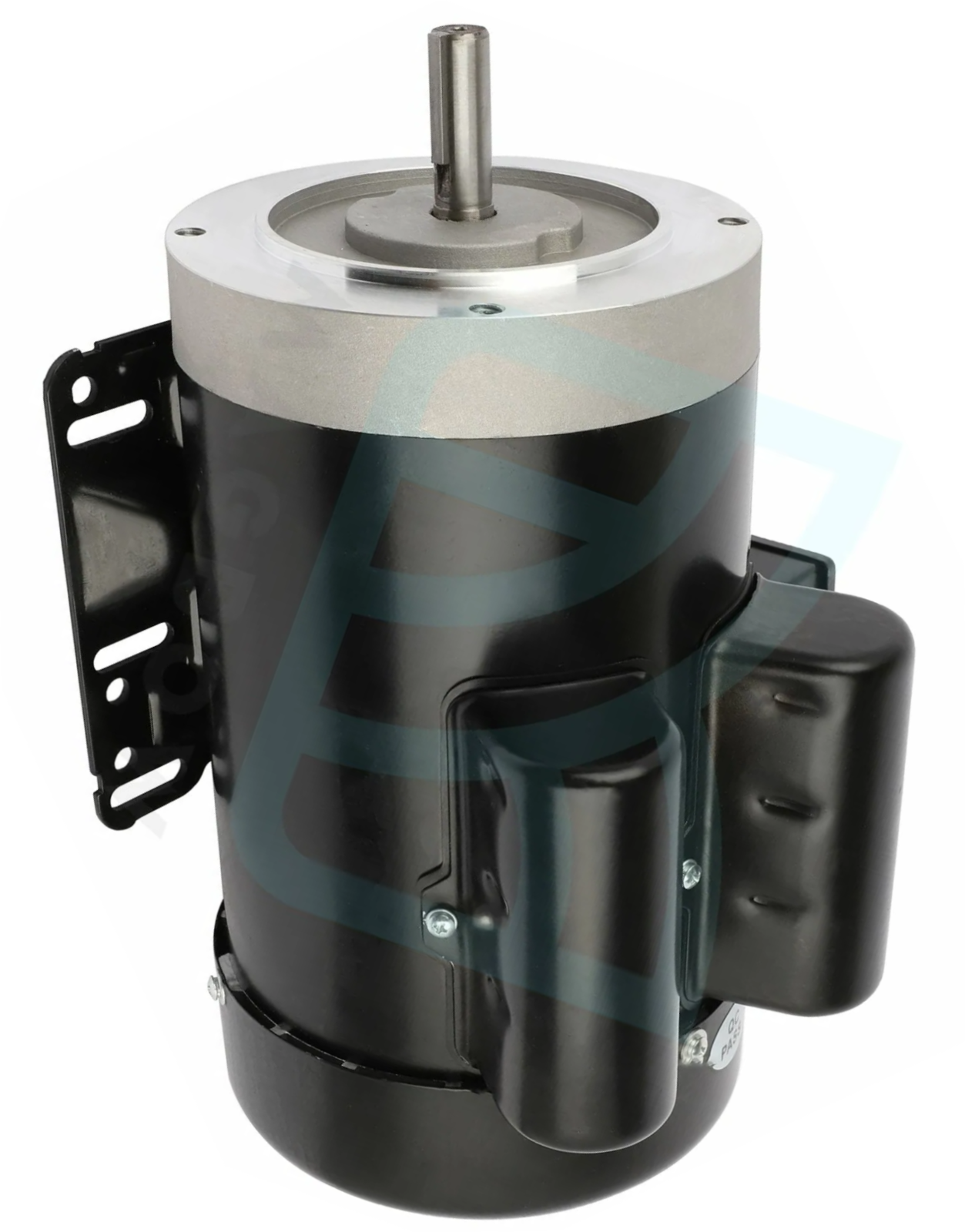
Most larger air compressors are driven by induction motors that are probably the most reliable component in an air compressor, but they are not bullet proof. It's important that their fans and air inlets are vacuumed (not blown) free of dust and lint. Likewise, you need to check the duty cycle and not run your motor beyond its rating. Many inexpensive compressor motors are rated for only a 20% duty cycle. This means running it for more than twelve minutes an hour can hurt the motor! Some of the small pancake compressors are driven by a series wound motor. If you find it necessary to replace the brushes, you may find it maddening to get at them. Pay close attention to disassembly order.
- Hoses
My friend who owned the compressor shop gave me a real eye opener in terms of hoses. Unlike catastrophic tank failures that are pretty rare, hose failures are common. He said one of the worst examples happened in his own garage. He had just bought a new car and had left his hose heaped in a pile next to his compressor when he stopped painting and went for lunch. The hose ruptured near the end and went flying all over the shop. The result left his pretty new car looking as though it had been beat with a hammer all over! Fortunately, his insurance company totaled his vehicle and let him go get another. His recommendation is to always buy good quality hose, an automatic hose reel to keep it wound up, and to replace any hose that becomes worn, frayed or that gets badly kinked!
- Specifications
- Requirements
As with any worthwhile effort, I started by defining my needs and my wants. In this case I wanted a top quality unit for myself, but was going to be using it for a host of activities that I knew little about. I started by making a list of my own requirements and what I knew of air compressors. I then went to the on-line web sites for the more respected air compressor makers and added to my list those features that they felt made their products superior. I then added to that growing list of the many air compressor advice posts from the Badger Pond, the Oak, and Wood Central woodworking forums that seemed to provide good information on air compressors, their selection, and their care. By the time I was done, my list had grown to many dozens of pages of all kinds of totally disorganized and in some cases contrary advice. I took that advice and rearranged it by topic and did considerable wording cleanup so it made some sense. To that list I then called upon Forrest Addy to help me with some of the contradictions and added his emailed responses.
I started with determining determine how much compressor I needed. I do mostly woodworking, some painting, and a little metal work. I own more than my fair share of tools, including some nice air sanders, light auto shop tools, a small portable sandblaster, and a few paint guns. I also wanted to learn how and get more into HVLP painting. I looked over the literature for each of my air tools and hoped for air tools making a list of what they needed in terms of pressure, cubic feet per minute (CFM) and what the duty cycles were on my tools. I learned the hard way years ago that if a random orbit sander maker says their unit needs 6 CFM at 90 PSI, it is really going to need 50% more or about 10 CFM airflow. If a 4" disk sander requires 9 CFM you need an 18 CFM compressor to run it, otherwise, you waste time waiting for the compressor to catch up. According to traditional wisdom, I sized my compressor at about double the largest air demand to make sure I got an appropriate compressor for my shop. All of my tools were 100% duty cycle meaning they could run as long as I could run them. Some tools, especially motors used in consumer air compressors need to only be run a percentage of the time or they will eventually overheat and burn up.
> My friend that owned the air compressor shop looked over my list of tools and their air requirements with me. As soon I mentioned I had spray guns and other air tools like my in-line sander, sand blaster, and a rotary sander, he said I had left the 115 volt plug-in-the-wall-outlet compressor bracket. He said all my air tools were under-rated for air consumption and very inefficient, even my expensive industrial tools. He said I need about 5 HP of compressor power to generate 1 HP of air tool power!
My friend Forrest added to this saying I should seriously consider giving up on my pneumatic sanders left over from ancient days when I used to do a little professional automotive body work. He said he uses electric sanders and avoids the whole problem of large compressors and rotary air tools with their carried over oil and water sprayed on his almost ready to paint projects. The electric 4" sanders have 115 volt 6 Amp motors that draw about 1/7 the juice of a 240 Volt 22 Amp compressor motor.
Here's a list of applications and motor HP and electrical demand in ascending order:Fill bicycle tires or run a nailer 1/2 to 1 HP (10 Amp @ 120 Volts)
Using a detail spray gun 2HP (9 Amp at 240 Volts) Because of its considerably reduced need for airflow, this is what most hobbyists should consider instead of buying a large industrial type gun.
General automotive use where air ratchets and impact tools are employed 3 to 5 HP (12 to 22 Amps @ 240 volts
Running a blast cabinet 3 to 7.5 HP depending on nozzle diameter (12 to 33 amps @ 240 Volts)
A typical spray gun requires 5 to 8 CFM. Doubling the largest rating equals 16 CFM. That requires a real 5 HP two-stage compressor whose induction motor draws 22 Amps @ 240 Volts.
My HVLP spray guns require 9 to 11 CFM which can easily exceed even the capacity of that 5 HP two-stage compressor!
- Recommendations
Based upon my set of tools, my friends said I had two choices. I could buy at least a 60-gallon tank with not less than a real 5 HP motor that will deliver at least 11 CFM at 90 PSI. Alternatively, I could buy a smaller unit and keep using patience as I did with my Craftsman while waiting for recovery and make sure I gave it time to cool down after use. The cost difference is about double, I decided on a quality smaller unit.
Here is the list of things they told me and that I already knew to consider in my air compressor purchase:Buy an oil bath unit because the oil-less tend to have heating problems that would not be good for the amount of spraying and sanding that I do, plus they are much more noisy.
They said there are two theories on compressors. Many prefer big slow pumps as they will wear forever. Others prefer mid sized units with a fast motor to permit quick recovery. Unless you have a really big unit, my friend with the air compressor shop prefers the slow movers. He recommends using top quality synthetic oil that you change as needed, depending on use, but not less than once a year. He uses the Ingersoll Rand synthetic oil because it is readily available at Home Depot.
They said I needed to decide if I wanted a stationary compressor or one that I could move around. They recommended the horizontal arrangement or one with a short squat tank and wheels if I was going to be moving it much. The tall ones he said have too high of a center of gravity and can be dangerous for one person to try to move alone. Still, the vertical ones use half the floor space. They're intended to be moved in and left in place because they are so top heavy.
Buy one with a motor rated for continuous duty, preferably a good American made motor with 100% duty cycle rating. My sanding and painting makes me an infrequent hard user, which is something many inexpensive imported limited duty motors were never meant to handle.
Get one with at least a 30 gallon tank, anything less is going to not have enough reserve to let me run either my HVLP or larger air tools for very long before having to wait for recovery.
Find a unit with an easily accessible drain line and replace it with a cable pull drain. Apparently, until you get in the hundred plus dollar range, the automatic drains are not worth bothering with.
Buy one with an oil sight gauge that makes it easy to check the oil every time the unit is used, then make sure you check it each time!
Buy one that makes it easy to change the oil. Many have the drain plugs setup so all you can do is make a huge mess draining your oil all over your compressor. He said he often replaced drain plugs with an oil drain line that he made up with a valve. This let the end of the oil drain go into a bucket for an oil change without giving the compressor an oil bath.
Buy one with a built in muffler or that can add one later.
If I buy an upright, go to an air compressor store and buy four of the rubber or neoprene and cork vibration pads to set that unit on to significantly reduce the noise level.
Make sure the unit has or buy a dual set of gauges, one for the tank pressure, and the other for the line pressure. Put another gauge on fittings so it can sit right before my paint spray guns, especially the HVLP unit.
Make sure to get one with or add a line turnoff valve at the tank and use it, as it is bad news to leave the hoses pressurized. Always let the line pressure out of the hose after use.
Buy all my air fittings at once from the same maker as mixing and matching always leads to leaks and frustration. They and many others said don't buy them from my Tools By the Pound store. Sticking with a popular brand name helps, as fittings can be added later and generally work without leaking.
Install a water filter with built in drain to protect my spraying. The size of that filter depends on how humid each area is. In my area, a tiny one is ample except in the wet winters.
Although there are many ways to plumb a shop for air, both of my experts recommended the same thing. Start with a heavy flex hose that connects the air compressor to wall mounted copper pipe. That flex hose takes care of the vibration of the compressor. Run the copper pipe up (or in) the wall and across the ceiling to a pull down self winding air hose reel located in the center of my shop. One recommended also running a line to my workbench and using one of those self winding curled little 6' hoses. Here is a site that gives a good idea on how to setup your air compressor lines and avoid water problems.
Copper pipe comes as either flexible tubing or rigid pipe. The flexible tubing is not suitable for an air line. The heaver "L" gauge rigid pipe is what I recommend but you can get by with the lighter "M" gauge. David Craig pointed out to me that the authority on copper pipe is http://www.copper.org/publications/pub_list/pdf/copper_tube_handbook.pdf and their Table 3 shows either the "L" or "M" rigid pipe in 1/2" diameter will work fine. My air compressor expert agrees. For sure use 1/2" pipe, as the smaller diameter pipe adds a huge amount of resistance and reduces airflow.
My friends recommended using sweated fittings to plumb the airlines and feed the hose reel. Don't forget particle and water traps at every service drop. You might want to look at this Copper Website for information on copper piping and what type of solder to use.
Both said PVC works and is plenty strong, but not something either would use. When this stuff gets old or cold enough it becomes so brittle it can easily explode.
Install your air lines so that they drain any water to your vertical run(s). At the bottom of each vertical run, put in an inexpensive finger operated drain to get rid of any condensation, then regularly drain those pipes (the box stores sell the inexpensive CH units).
Buy a nice self-winding hose reel and mount it centrally on the shop or garage ceiling. The hose reel is not just a convenience, it is also an important safety item as it keeps the hose under control if it should rupture.
Always buy a good quality air hose of at least 3/8" interior diameter with at least a 300 PSI rating. Make sure you limit your air hose to about 25 feet as longer lengths really degrade the airflow. If you really do need a long hose, seriously consider moving up to 1/2".
- Making a Choice
For me it came down to buying one of the big Campbell Hausfeld from Home Depot, a big two stage oil-less unit from Sears, an Ingersoll Rand from HD or Harbor Freight, a Coleman Black Max from Sam's, or the similar unit from Costco. They all looked pretty much the same, so I again called for help, plus asked for help on the few woodworking forums I follow.
I got a lot of advice and some very strong opinions on a few units.One fellow said he was suing one well known vendor after having bought their oil-less two stage compressor. He says it is a true two stage compressor and will deliver 175 PSI, but not at all suitable to power paint guns or rotary air tools both because it can not handle the required continuous duty and its performance is far below what the vendor rates it at. As a result, once the tank gets drawn down, the compressor will not be able to keep up, so it burned up. Many others made similar comments about their single stage consumer units saying they simply burned up the first time they used them hard.
The advice from those who seem to best know their stuff was consistently to buy either Quicy or Ingersoll Rand. Many had good things to say about the Ingersoll-Rand units sold by Home Depot. The consensus was to buy the Ingersoll-Rand Garage Mate from Home Depot and others for about $466 if money was driving my decisions. If not, then go for the 5 HP two stage Ingersoll-Rand compressor that Home Depot sells. My friend Forrest recommends it as the best buy he has seen for the home shop user (no plug intended). My local Home Depot carried this unit in two identical models, except one had a 60 and the other an 80 gallon tank. I've since learned that quite a few firms sell these units on the Internet, a few with no shipping charges. It is worth your while to use Google search engine to help with your price shopping.
I looked one over and decided the upright version of the Garage Mate was right for me. With a big Spring project, I opened my wallet, saw a few moths fly out, and went to my local Home Depot. They were sold out! After lots of calls I found a distant Home Depot that had one. In my running around I also found a near new bigger two stage Ingersoll-Rand for sale at a ridiculous low price. I bought home that 80-gallon unit sold by Home Depot. It turns out that they had taken that unit back after just minimal use, so had marked it way down to a price of about the same as a Garage Mate and offered their full warranty! Other than being huge and taking more room than I expected, it runs like a champ!
You are my visitor!
Thanks for dropping by!
DISCLAIMER: Although I have made every effort to ensure the accuracy and currency of this site, I can not guarantee the long term viability of this advice, nor the safety of any particular implementation. As skills vary widely among individuals, it is the responsibility of THE READER to determine what is considered to be safe. Therefore, I assume no liability for the posting or linking of any content on this page, or in this site.Folks, this is my hobby. I share what I have done for you to use as a starting point for your own creations and growth. If you don't have the skills and are not willing to take the time to build or buy something functional and safe, then don't go there! FONT>
- Acknowledgements